Tuesday, January 17, 2012

Turkey Adds 63 Tonnes of Gold Due to Acceptance of Metal as Reserve Requirement from Banks

Posted 1/17/2012 1:49 AM by Vittorio Hernandez from International Business Times in InvestingCommodities


The acceptance of gold as a reserve requirement held by Turkish banks led to a rise of holdings of the yellow metal. In November, Turkey added 63 tonnes of gold, which boosted the purchase of gold by 41.3 per cent. It was the largest increase in gold buys that month.
In October, Turkey also boosted its gold stock by 21.7 per cent. Besides Turkey, the only country that increased significantly purchase of the safe haven metal is Korea by 15 per cent, according to the World Gold Council (WGC) report released on Tuesday.
The International Monetary Fund ( IMF ) data showed that the Turkish central bank hiked its gold reserves to 5.758 million ounces in November from 4.429 million ounces in October.
Besides the two countries, Russia also continued to accumulate gold by boosting its holding of the yellow metal to 81,000 ounces. With the latest addition, the country's gold reserves had gone up 11 per cent compared to the start of 2011.
With Turkey's addition of more gold holdings, the country is the 22 nd largest holder of the precious metal in the world with a total of 179.1 tonnes of gold which comprises 10.6 per cent of the country's reserves.
The U.S. continues to be the largest holder of gold with 8,133.5 tonnes in its possession, which is 76.9 per cent of the country's reserve requirements. It is followed by Germany (3,396.3 gtonnes), the IMF (2,814.1 tonnes), Italy (2,451.8 tonnes) and France (2,435.4 tonnes), according to the latest WGC report.
The Turkish Central Bank announced on Oct 24, 2011 the new policy that allowed up to 10 per cent gold holdings of the reserve requirements for lira liabilities to strengthen the country's build-up of gold reserves and provide more flexibility in the country's banking system's liquidity management.
Based on the new policy, about $3.5 billion worth of 55 tons of gold would be maintained by the Turkish Central Bank.


Read more: http://community.nasdaq.com/News/2012-01/turkey-adds-63-tonnes-of-gold-due-to-acceptance-of-metal-as-reserve-requirement-from-banks.aspx?storyid=114553#ixzz1jlqpidxG

Monday, January 16, 2012

James Turk: 2012 to See Much Deeper Banking & Currency Collapse


from King World News:

Today James Turk informed King World News that we are now headed into a vortex, and the Lehman event was a warm-up to a much deeper, widespread crisis and collapse which lies ahead. Here is how Turk described the warning signs and what to expect: “There are all of these warning signs out there and few people are paying attention. For example, hardly anyone cares that the US has lost its AAA rating and most dismiss it as a non-event. But even a cursory look at the US government’s financial position should raise investors concerns that it will not be able to meet all of its obligations.”
James Turk continues: Read More @ KingWorldNews.com

Saturday, January 14, 2012

Foreigners Sell Record $85 Billion In Treasuries In 6 Consecutive Weeks - Time To Get Concerned?


Foreigners Sell Record $85 Billion In Treasuries In 6 Consecutive Weeks - Time To Get Concerned?

As the chart below vividly demonstrates, the traditional diagonal rise in foreign holdings of US paper has not only plateau, but it is in fact declining: a first in the history of the post-globalization world.
Well as of today's H.4.1 update, the outflow has increased by yet another $8 billion to a new all time record of $85 billion, in 6 consecutive weeks, which is also tied for the longest consecutive period of outflows from the Fed's Custody account ever. This week's sale brings the total notional of Treasuries in the Custody account to just $2.66 trillion (down from a record $2.75 trillion) and the same as April of last year.
This zerohedge.com piece from yesterday was sent to me by West Virginia reader Elliot Simon.  The graph is worth a quick look...and the link is here.

Thursday, January 5, 2012

For the first time in history, Silver Eagle & Maple Leaf sales will surpass domestic silver production in the U.S. and Canada in 2011


Silver Eagle & Maple Leaf Sales Up As Supply Slips

Commodities / Gold and Silver 2012Jan 05, 2012 - 03:25 AM
Best Financial Markets Analysis ArticleFor the first time in history, Silver Eagle & Maple Leaf sales will surpass domestic silver production in the U.S. and Canada in 2011
The demand for American Silver Eagles and Canadian Maple Leaf coins has increased tremendously over the past several years.  2011 will be the first year in which official coin sales will surpass domestic silver production in both countries.
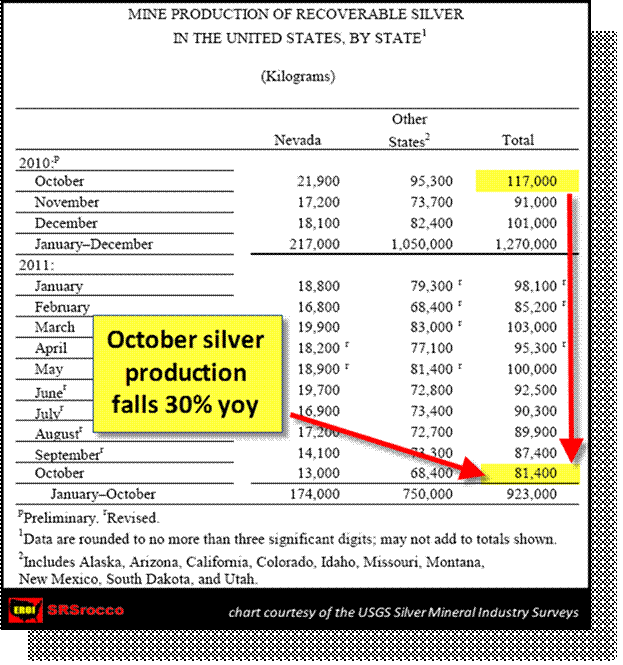
Even though each country has seen declines in their domestic silver production over the past decade, U.S. silver production declined a whopping 30% yoy (year over year) in October.  According to the USGS in their most recent Silver Mineral Industry Survey, silver production fell to 81,400 kilograms in October— compared to 117,000 kilograms the same time last year.
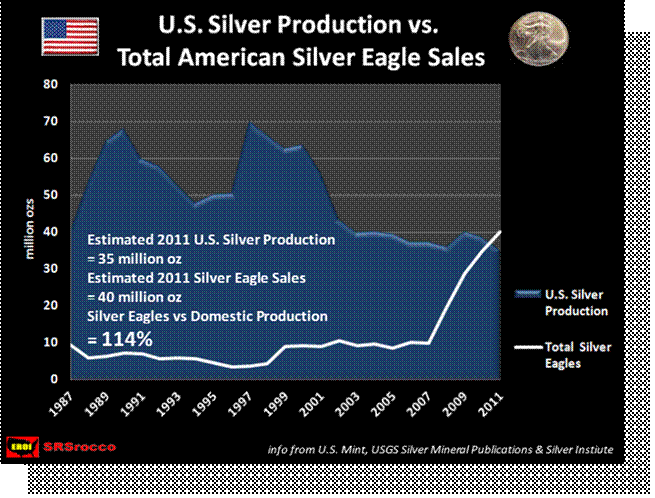
As of October this year, the United States has produced 923,000 kilograms or 923 metric tonnes of silver.  This number will change as revisions are made, but currently U.S. silver production is down 15% compared to the first ten months of 2010.  At this rate, the U.S. will produce an estimated 35 million ounces of silver this year.  This is significant, as production will yield less than the approximate 40 million ounces of American Silver Eagle sales for 2011.
American Silver Eagle Sales Overtake Total U.S. Silver Production in 2011
Here we can see that U.S. silver production has declined 50% since its high of 70 million ounces in 1997.  In 1997 American Silver Eagle sales were 3.6 million, which accounted for only 5% of domestic silver production.  Contrasted to today, Silver Eagle sales are estimated to reach 40 million while domestic mine supply will decline to 35 million ounces in 2011.  Thus, American Silver Eagle sales will be 114% of the total U.S. silver supply in 2011… what a difference in 14 years.  This trend is also taking place in the country’s northern neighbor.
Canadian Maple Leaf Sales Outperform Silver Eagles in Percentage Growth
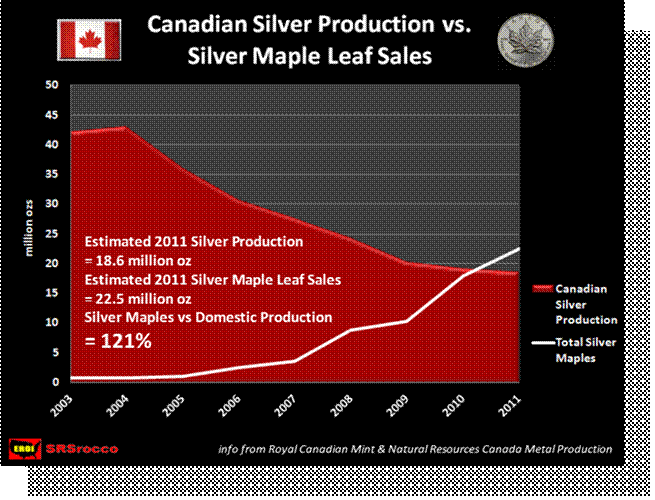
Canadian silver production has declined 57% from its recent high in 2002 at 44.1 million oz to an estimated 18.6 million oz this year.  According to the Royal Canadian Mint’s 2003 Annual Report (and including figures from previous years), there were only 576,196 Silver Maple Leaf coins sold in 2002— making up about 1.3% of the total Canadian domestic silver production.
In 2011, this figure is estimated to reach approximately 22.5 million Silver Maple Leaf (SML) sales or almost 30% higher than its previous year’s total of 17.9 million.  In comparison, 2011 American Silver Eagle sales are estimated to increase only five million sales over last year’s figures— or a 15% increase.
In the graph below we can see just how apparent this change of domestic silver supply vs. SML demand has become in the past several years:
The figure of 22.5 million SMLs for 2011 was estimated from the data obtained from the Royal Canadian Mint’s Third Quarter Report Fiscal 2011:
Sales of Silver Maple Leaf (SML) coins jumped to 6.1 million ounces during the quarter from 4.5 million ounces in the same period in 2010….During the 39 weeks to October 1, 2011, sales of SML coins increased by 56.1% to 17.8 million ounces.
If we consider that American Silver Eagle sales have declined in November, it would be appropriate to conclude that Silver Maple Leaf sales did as well.  Assuming that fourth quarter SML sales would be approximately five million (as expressed in current trends) it would give us a figure of 22.8 million oz in 2011… rounded down to 22.5 mil oz to be conservative.
If these figures are correct and the Royal Canadian Mint does sell 22.5 million Silver Maple Leaf coins in 2011, it will be at a rate of 121% of their domestic silver production.  2011 will be the first year in which both the U.S. and Canada will sell more Silver Eagles & Maples than what is available from their respective silver mining supplies.
Does the U.S. Mint Have to Use Domestic Silver Mine Supply for its Silver Eagle Production?

There has been a great deal of discussion on the internet on whether or not the U.S. Mint is by law forced to use domestic silver production for their minting of American Silver Eagles.  I have spoken with Michael White at the Office of Public Affairs at the U.S. Mint concerning this issue.  Mr. White provided me the link to Senate Bill S. 2954, passed into law in 2002, which allows the U.S. Mint to purchase silver on the open market to produce American Silver Eagles.  Wikipedia has also documented this below:
Program extension, 2002
The authorizing legislation for the American Silver Eagle bullion program stipulated that the silver used to mint the coins be acquired from the Defense National Stockpile with the intent to deplete the stockpile's silver holdings slowly over several years. By 2002, it became apparent that the stockpile would be depleted and that further legislation would be required for the program to continue. On June 6, 2002, Senator Harry Reid (D-Nevada) introduced bill S. 2594, "Support of American Eagle Silver Bullion Program Act," "to authorize the Secretary of the Treasury to purchase silver on the open market when the silver stockpile is depleted." The bill was passed by the Senate on June 21 and by the House on June 27 and signed into law (Pub.L. 107-201, 116 Stat. 736) by President Bush on July 23, 2002.
If it were true that domestic silver was required to mint these coins, the U.S. Mint would have only produced approximately 35 million oz of Silver Eagles in 2011— instead of the supposed 40 million currently estimated.  This is also true for the Royal Canadian Mint as it is now producing more Silver Maples than it can supply through Canada’s own domestic silver production. 
Even though the U.S. and Canada produce more Silver Eagles and Maples than their domestic mine supplies, neither country has regarded this as a problem because they each have enough imported silver to meet all of their industrial and investment demands.  However, this situation may change in the future as the global economy worsens and each country loses further trust in their respective fiat currencies.
The Myth Behind the So-called Silver Surplus
The investing public has been led to believe that the world is now producing a surplus of silver.  This so-called surplus was provided by information put forth by GFMS.  According to GFMS and its World Silver Surveys, there has been an annual global deficit of silver since 2003.  In 2004 the world hit its first small surplus and has continued to grow.   In 2010, the surplus was 175.4 million ounces.
To get its annual supply-deficit figure, GFMS uses a certain equation:
(Mine Production + Silver Scrap) – (Fabrication - Coin & Medal) = Surplus- Deficit
If we plug in 2010’s figures this is the result:
(735.9 + 215) = 950.9 – (878.8 - 101.3) = 775.5 = +175.4
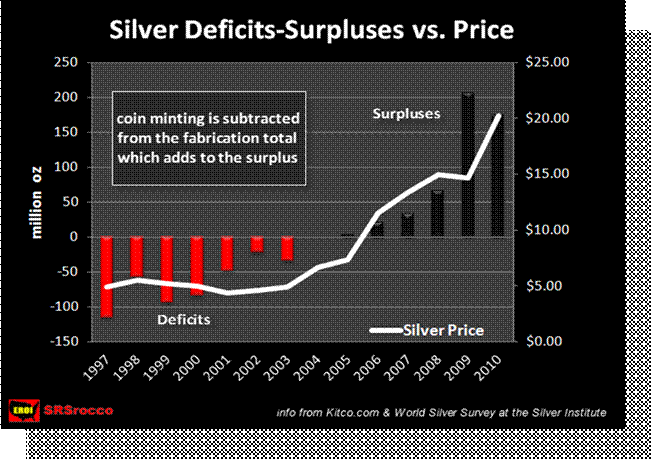
GFMS has decided that coin and medal demand should not be included in the Fabrication total but rather as a form of bullion supply.   So the higher the coin and medal demand, the more it adds to the so-called silver surplus.  The majority of this category of “Coin & Medal” consists of official government coins that are in high demand and are not of the type that would be sold for melt and recycled back into scrap supply.  If we look at the chart below, we can see how GFMS has created this so-called silver surplus:
101.3 million of those 175.4 million oz of so-called surplus came from coin & medal demand in 2010.  I find it interesting that GFMS has decided to treat the “Coin & Medal Category” (the majority of which are coins not readily available for melt and recycle) as supply rather than demand, but allow silver scrap from recycled fabrication to be used as a form of supply. 
If we think about it for a minute, the whole idea of a surplus as expressed by GFMS is nothing more than an accounting gimmick.  In 2010, there was 215 million oz of silver scrap added to the total supply.  A large portion of this amount came from recycling silver from industrial scrap.  Every year a certain amount of silver supply goes into industrial fabrication and of that amount, a percentage gets recycled into silver scrap which becomes supply in the following years.
Ask yourself this question… what would be considered more of future supply?  Would it be comprised of official government coins that are in high demand and held for many years for their investment potential or a percentage of recycled silver from industrial fabrication?  Even if investors sell Silver Eagles or Silver Maples back to a dealer, that dealer normally resells these coins back to other investors.  These coins are the least likely to be melted and recycled.
Even if we were to go by the GFMS and their silver surplus vs. deficit figures, there is another interesting trend taking place.  As coin and investment demand has risen, so has the price of silver.  During the years attributed to a silver deficit, the price of silver remained relatively flat.  As the so-called surplus has increased, so has the price of silver.  Either way, silver investment is pushing the price of silver higher. 
There have been several analysts who have stated that future silver surpluses will keep a lid on the price of silver.  Here we can see that this is not the case at all.  On the contrary, it has been due to investment demand that both the price of silver and the so-called surplus supply have grown.
The Coming Paradigm Shift in Silver
This is the subject of my next article which will be out shortly.  The paper-backed situation in the world’s economies and financial system is grim.  Silver should be priced at a level several times higher than it presently trading.  Too many investors are becoming hypnotized by the technical analysis.  However, technical analysis is a valuable tool in a FREE MARKET.  Unfortunately, the markets and the silver charts are being manipulated while analysts who recreate these charts in their articles may not realize that they are actually helping the manipulators do their work by legitimizing its function on the internet’s financial websites. 
Even though supply and demand factors contribute to the price of silver, it will be the shift in psychology that will propel the price of silver towards the heavens.  This psychology has been slowing changing as the graphs above reveal an interesting trend taking place in the U.S. and Canada.  In 2002 both countries produced 87.5 million oz of silver and sold 11 million Silver Eagles and Maple Leaf coins.  These coins sales accounted for 12.6% of U.S. and Canadian silver production.
In 2011, just nine years later, the U.S. and Canada are estimated to mine only 53.6 million oz of silver combined, while their total Silver Eagle and Maple Leaf coin sales are to surpass approximately 62.5 million.  Thus, their coin sales are 16% greater than their total domestic silver mine supplies.
Investors in increasing numbers over the years have been buying physical silver.  While this number is growing, it is still a fraction of a fraction of the country’s population.  Even though 40 million Silver Eagles were sold in 2011, this accounts for one coin for every eight Americans. 
The Great Stampede in Silver is yet to come.
UPDATE:  Since the completion of this article, the U.S. Mint has updated its 2011 American Silver Eagle sales.  The grand total for 2011 turns out to be 39.8 million Silver Eagles sales while the month of January 2012 starts off with a whopping 3,197,000 sales on the first business day of the year.   This is speculation on my part, but instead of updating the Silver Eagle figures during the last few days of 2011(as it normally does on a more regular basis), the U.S. Mint decided to dump all the remaining sales onto January 2012.
Steve St .Angelo Independent researcher residing in southwest Utah


Tuesday, December 13, 2011

Wow! China’s imports of Gold Spike 4000% yoy

UK-based International Business Times reports China’s gold imports spiking 50 percent in October from September, and soaring 4,000 percent from October of a year ago, to an all-time single-month record high of 85.7 tons.  Sign-up for my 100% FREE Alerts
Though India’s anticipated record gold imports of a 1,000 tons this year could slow due to signs of slowing jewelry demand from a recent 20.3 percent crash in the rupee, since August, investors can no doubt count on China to, not only take over the gold market slack, but soon-to-dominate the New York-London gold cartel
As a reminder to evolving drama in the gold market, WikiLeaks exposed China’s plan to break from its sadistic recycling of trade surpluses into U.S. Treasuries, a shift in strategy by Beijing that’s prompted other Asian nations to follow suit.  See BER article, WikiLeaks Drops Bombshell on gold Market, GATA right again!
Source: U.S. embassy cable – 09BEIJING1134
According to China’s National Foreign Exchanges Administration, China’s gold reserves have recently increased. Currently, the majority of its gold reserves have been located in the United States and European countries. The U.S. and Europe have always suppressed the rising price of gold. They intend to weaken gold’s function as an international reserve currency. They don’t want to see other countries turning to gold reserves instead of the U.S. dollar or euro. Therefore, suppressing the price of gold is very beneficial for the U.S. in maintaining the U.S. dollar’s role as the international reserve currency. China’s increased gold reserves will thus act as a model and lead other countries toward reserving more gold. Large gold reserves are also beneficial in promoting the internationalization of the renminbi.
And the promotion of the “internationalization” of the renminbi has noticeably accelerated this year.  On a year-over-year basis, the amount and rate of increase of gold purchases by the People’s Republic of China is no less impressive than the $3.2 trillion of foreign reserves slated to be deployed by Beijing.
IB Times quotes Credit Suisse analysts Thomas Kendall, who sees “Chinese imports of the yellow metal hitting 470-490 tonnes for the full year, up from last year’s 245 tonnes,” a near-double spike in volume anticipated at the close of 2011.
And it appears that the Chinese are patient when accumulating gold, outside of its steady purchases from its own China-based mining industry, buying on opportunistic dips created by periodic hedge funds selling.  In fact, the notorious sell offs in the gold market plays into the hands of the masters of Sun Tzu (1), as September’s swoon from one large hedge fund manager provided attractive prices for Beijing’s rapid gold accumulation program.
“Analysts said the [gold] buying, led by emerging market central banks intent on diversifying their growing foreign exchange reserves, helped explain gold’s rebound from a low of $1,534 a troy in September as large hedge funds such as Paulson & Co were forced to sell some gold to cover losses elsewhere,” stated the Financial Times of London on Nov. 17.
After dominating the world economy in production and exports of the past two decades, Beijing’s next Mao-like ‘Great Leap Forward’ enlists 100s of million of China’s middle class in a joint venture with its central bank to now wrest control of the gold market away from New York and London.
As the world witnessed the powerful rise of China, post Tiananmen Square, the power of 1.3 billion Chinese, encouraged and mobilized by a centrally-commanded political structure to achieve an objective vital to its national security can produce awesome results.  As the WikiLeaks cable exposes, today, Beijing is out to break the gold cartel with its awesome population might.
Since 2002, after lifting the 53-year ban on gold ownership under Mao Zedong, the Chinese have eagerly scooped up gold coins and jewelry at rapid rates, to numbers which now rival India’s colossal demand for the yellow metal.
Forbes Magazine reported in March, “Believe it or not Ripley! The People’s Bank of China (PBOC) recommended yesterday that 1 billion Chinese consider buying gold as a hedge against inflation and to preserve values in a world where currencies can fall. . . . Wow! Be like the Fed telling you to buy oil stocks or crude oil futures due to expectation higher gasoline prices this summer.”
According to the World Gold Council, total gold demand in the PRoC will reach 750 tons in 2011.  In the third quarter, consumer demand for the precious metal continued to soar, led by a 24 percent increase in demand of 60.2 tons of gold bars and coins, from last year’s third quarter total of 48.5 tons, while demand for jewelry rose 13 percent.
Front-running China’s demand
Frank Holmes, contributing editor for Forbes Magazine penned an article, today, titled, Central Bank Appetite And The Monetary Case For $10,000 Gold.  Holmes sees what the Chinese see: a tsunami of money creation coming out of the U.S. and the ECB, whose combined currencies comprise approximately 88 percent of all central bank reserves.
In the Forbes article, he quotes long-time friend and founder of Goldcorp’s Silver Wheaton, Frank Giustra:
The bottom line is that the money needed to bail out Europe and to fund America’s spiraling debt and future unfunded obligations is in the tens of trillions. IT DOES NOT EXIST.
It has to be created by printing money in massive quantities, and despite all the rhetoric you will hear against such policies, in the end it’s the path of least resistance. Printing money is an invisible tax on savings, much easier to initiate, than, say, raising taxes or cutting back on services and entitlements.
Under the Holmes scenario, which, incidentally, has become an ever-increasingly common conclusion, drawn by many well-respected analysts, the gold price could move as high as $10,000 per ounce in coming years.  That means: the dollar and euro are expected to erode significantly in purchasing power during that time period.
As far as the question: when is a good time to buy gold?  Stephen Leeb, author of Red Alert: How China’s Growing Prosperity Threatens the American Way of Life, has researched China and its strategic initiatives for the coming 20 years.  According to him, just jump in and wait, because a few hundred dollars here, or there, won’t amount to much in the long run.
“So how low gold will go here is literally meaningless,” Leeb told King World News on Monday.  “My advice to investors is don’t try to catch a bottom and be a hero.  It could happen any time.  It could be happening as we speak, it could be happening today.  But it’s really irrelevant.  Let’s say gold is at $3000, $4,000 or $5,000 in three or four years, which I think is very, very likely–are you really even going to remember that it went to $1,650 or $1,550?  No.”
(1) From Wiki: The book was first translated into the French language in 1772 by French Jesuit Jean Joseph Marie Amiot, and into English by British officer Everard Ferguson Calthrop in 1905. Leaders as diverse as Mao Zedong, General Vo Nguyen Giap, Baron Antoine-Henri Jomini, GeneralDouglas MacArthur, Napoleon, and leaders of Imperial Japan have drawn inspiration from the work. The Art of War has also been applied to business and managerial strategies.


Read more: http://www.beaconequity.com/wow-china-gold-imports-spike-4000-y-o-y-2011-12-13/#ixzz1gSqAv1Bw

Sunday, November 20, 2011


morganI spoke today with “The Silver Guru” himself, David Morgan, publisher of The Morgan Report. David moved subscribers into silver over ten years ago.
In today’s interview, David shares his thoughts on the MF Global collapse and why it’s explosively bullish for gold and silver physical bullion. Additionally, David feels gold may break $1900 in the first quarter of 2012. On mining shares, David feel’s they’re oversold, and offer a unique value at these levels.
To listen to the interview, right click the following link and/or save to to your desktop:gold grenade
To learn more about The Morgan Report and follow David’s work, visit:

World Silver Investment Has Increased 1,150% In The Past 4 Years According To Silver Institute!

Sunday, November 6, 2011

Silver Manipulation And CFTC's evasion after 3 years investigating silver is answer enough


By: Chris Powell, Secretary/Treasurer, GATA


-- Posted 5 November, 2011 | Share this article | 

Dear Friend of GATA and Gold (and Silver):
Under renewed pressure by Commissioner Bart Chilton to account for itself, the U.S. Commodity Futures Trading Commission today issued a statement about its 3-year-old investigation of manipulation of the silver market, asserting only that the investigation continues.
Those who have been taking the CFTC investigation seriously may wax indignant over the delay in resolution. But the delay speaks for itself, and eloquently: Thanks to the complaint about market rigging by London silver trader Andrew Maguire and GATA's publicizing it at the CFTC's March 25, 2010, hearing and agitating about it afterward, the CFTC has probably realized that the rigging of the silver market is, like the rigging of the gold market, a U.S. Government operation conducted through intermediaries, primary dealers in U.S. Government securities, and thus can't be examined in public without crashing the operation and impugning the whole government of which the CFTC is a part.
The CFTC well may expect that the silver business can be resolved by a confidential settlement of the class-action lawsuit brought against the main silver market manipulator, JPMorganChase, in U.S. District Court for the Southern District of New York. (See the lawsuit's consolidated complaint here: http://www.gata.org/node/10448.)


If the lawsuit survives a summary judgment dismissal motion by JPMorganChase, which seems likely, insofar as such a motion must presume that everything alleged in the complaint is true, the lawsuit may be worth a few hundred million dollars to the investment bank just to prevent any hostile law firms from inspecting its books and interrogating its traders and managers in court-ordered discovery and deposition. Such a settlement will make the plaintiffs' lawyers very rich and let the CFTC off the hook even as it leaves the public with no formal finding of what actually happened.
Will it end the manipulation of the silver market, or will that manipulation be ended by whatever futures market position limits the CFTC eventually decides to enforce? Maybe -- or maybe JPMorganChase will find intermediaries through which it can continue to enter the market in disproportionate size and thus continue to control it.
In any case silver investors probably should be thankful enough that the CFTC held that hearing a year ago in March and thankful particularly to Commissioner Chilton for insuring that GATA Chairman Bill Murphy and GATA Board of Directors member Adrian Douglas were allowed to speak and introduce Maguire's complaint in detail. On the day of the hearing silver was hovering around $15 per ounce and had been going nowhere in particular. By the end of the year it had doubled and this week it closed above $34, and there are many signs of its physical shortage as the paper hangers of the fractional-reserve precious metal banking system thrash around desperately to regain control of the market.
Anything beyond this would require one agency of the U.S. Government to execute other agencies of the government, agencies much bigger and more sinister. Most likely the CFTC would be executed first. Indeed, GATA often worries for Chilton's safety and is sometimes surprised that he hasn't already been found in circumstances making it appear that he had been struck by lightning, a meteorite, or a freight train.
So thanks, CFTC, but we don't need your silver investigation anymore. You've already told us all we need to know.
The CFTC's statement is appended.
Additional comments made by Chilton today to King World News, regarding the collapse of the trading firm MF Global, can be found here:
http://kingworldnews.com/kingworldnews/KWN_DailyWeb/Entries/2011/11/5_Ba...
CHRIS POWELL, Secretary/Treasurer
Gold Anti-Trust Action Committee Inc.

* * *
CFTC Statement Regarding Enforcement Investigation of the Silver Markets
Press Release
U.S. Commodity Futures Trading Commission
Friday, November 4, 2011

http://www.cftc.gov/PressRoom/PressReleases/silvermarketstatement
WASHINGTON -- The Commodity Futures Trading Commission today issued the following statement:
In September 2008 the commission announced the existence of an enforcement investigation into the possibility of unlawful acts in silver markets. Since that time, the staff has analyzed over 100,000 documents and interviewed dozens of witnesses and obtained expert advice. It has been a long, detailed, and thorough investigation, and it continues in an appropriate and considered manner."

Wednesday, November 2, 2011

Chinese Silver Investment Going Parabolic


When 1.3 Billion people start investing in something…you might want to pay attention.
Chinese investment in silver has exploded since last year, with the trading volume going exponential. The China Daily reported today that the trading volume of silver forwards on the Shanghai Gold Exchange (SGE), China's only exchange for the precious metal, surged 751 percent year-on-year in 2010. Meanwhile, the volume in September of this year was more than six times that of the same period in 2010.
Chinese commercial banks are now selling silver to investors in the hundreds of tons. One example is the Industrial and Commercial Bank of China Ltd (ICBC), China's biggest lender which launched paper silver trading for individual investors in August of last year. The other large Chinese Banks have also introduced silver trading. The trading volume of ICBC's paper silver products alone reached 300 tons in the first half of 2011, almost four times the figure for the whole of 2010. That's right, one Chinese bank alone sold 300 tons or over 10.5 million ounces of silver in only 6 months. In only their first year of trading, ICBC bank alone will sell over 20 million ounces of silver which alone would represent over 2% of the total amount of silver mined on earth for the entire year.
The key factor to pay attention to is that most of these silver purchases are forward contracts and not the actual physical silver. What happens when Chinese investors demand physical silver instead of paper silver?
Modern day commodity markets are characterized by a continuing divergence between the “paper” and the real “physical” markets. The Chinese silver market is no different.
Most commodities trading takes place between parties than have no physical supply of the materials. In the Silver market, the distortion between the physical and paper markets is extreme. Every day in the global markets, $50 Billion dollars of silver can be sold daily by parties that actually own no silver. The global silver market will trade 1 billion ounces daily in global markets which is more than the entire amount of silver mined each year, which is close to 900 million ounces.
Demand for precious metals in China is skyrocketing. High inflation and a lack of investment options are the main culprits. With new housing regulations bringing housing investment to a standstill, investors are looking for new ways to invest cash. The housing market looks to go down and the stock market is widely viewed as corrupt and risky. Gold and silver are becoming increasingly popular.
China’s net imports of silver hit a record high in 2010 with the volume quadrupling to a total import amount of 3,500 tons. This is a major shift as China was previously a net exporter.
In China, silver has served historically as the main medium of exchange in China. It was an official currency in China as far back as the Han Dynasty (206BC-220AD). Silver Ingots were used to horde wealth and Silver Taels were produced by the government to function as currency or to back a paper currency. The Chinese word for “Bank” is literally translated as “Silver House”.
Chinese silver trading is largely a paper market today. Chinese Banks are selling paper silver in massive amounts which will no doubt continue to double or triple year after year. These paper silver contracts are redeemable in silver bars at the banks yet the banks do not have the silver. Chinese investors are often fickle and enjoy hard assets. What kind of short squeeze will develop when Chinese banks are forced to go onto the open market and buy physical silver to support Chinese investors when they switch from paper silver to physical silver?
What is the Mandarin term for “The mother of all short squeezes”?